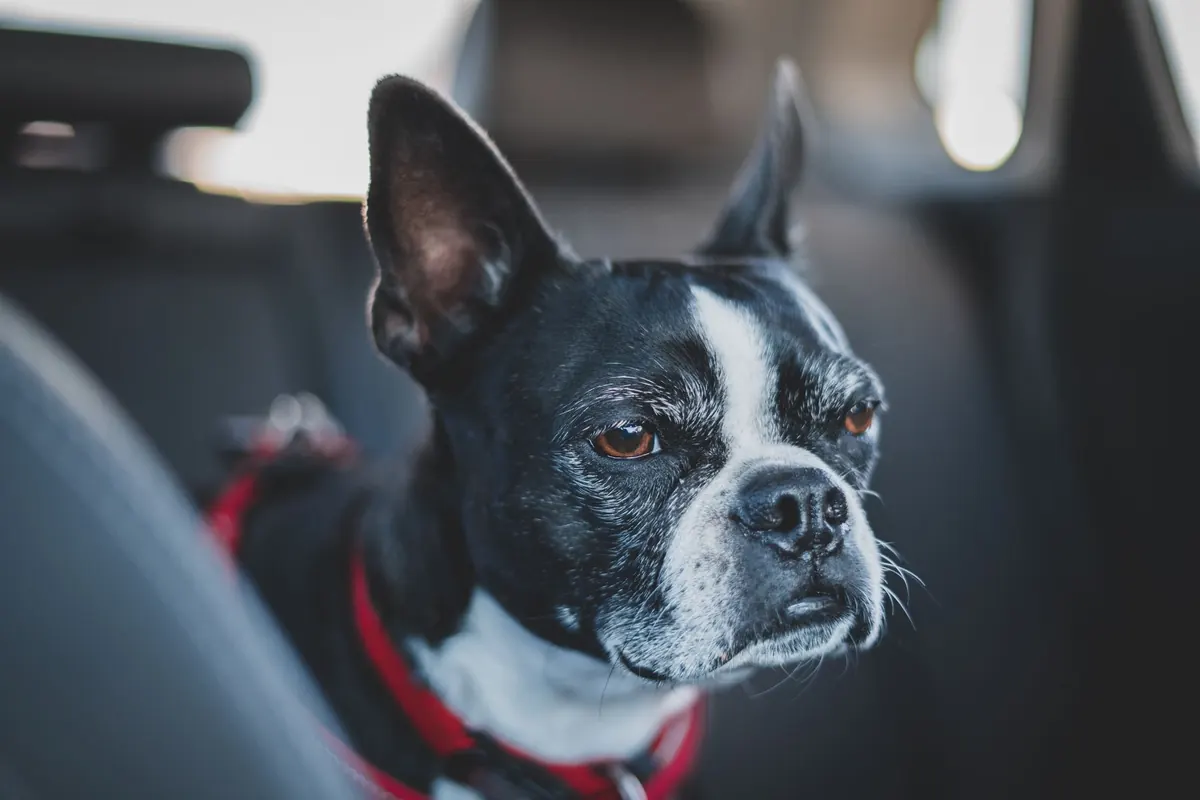
A ten-pound terrier riding loose on the back seat is not a small problem. In a sudden stop she becomes a moving object, and the driver's instinct to reach back and catch her is its own hazard. Small dogs are portable, which is exactly why they end up unrestrained on someone's lap. The four categories below — carriers, booster seats, seat belt harnesses, and seat covers — solve three problems at once: keeping your dog contained, keeping her comfortable, and keeping the upholstery from turning into a fur-and-mud collection site.
Start With Measurements, Not Marketing
Sizing labels on pet gear are wildly inconsistent, so measure your dog before you shop. You need three numbers: length from chest to tail base, standing height from floor to the top of the head, and weight. For weight, step on a bathroom scale alone, then again holding your dog, and subtract. Write all three down and keep them on your phone — you will need them for every product you compare.
For a carrier, add one more test: your dog should be able to stand up, turn around, and lie down flat inside. If she has to crouch, the next size up is the right size. For a booster seat or harness, check the manufacturer's weight range and then measure your car — seat depth, headrest spacing, and whether the rear seats fold flat all affect what will actually fit.
Dog Carriers: Containment for Nervous Travelers
Soft-sided carriers are the easier starting point. They are light, usually fold flat for storage, and have mesh panels that let air move. Look for a firm frame or wire that keeps the shape from collapsing, mesh on at least two sides, a washable pad, and an internal tether to clip onto a harness. Some dogs learn to open zippers with their noses, so locking clips on the pulls are worth having.
Hard-sided crates offer more protection in an impact, but only if they are secured. A loose crate slides and tips; a secured one stays put. Run the seat belt through the handle or use a dedicated crate strap, and position the crate on the seat rather than in the cargo area of a hatchback, where it can shift. If you plan to fly with your dog, confirm the airline's current carrier requirements before you buy — they vary by carrier and route.
Booster Seats: A Window Seat for Small Dogs
Booster seats lift a small dog to window height, which often quiets whining because she can finally see out. Most are designed for dogs up to roughly fifteen to twenty pounds, but check the specific product's limit rather than assuming.
The important detail is the tether. A booster seat without a harness tether is a padded box; the seat raises your dog, and the tether restrains her. Clip it to a harness, never to a collar. Look for a strap that loops around the seat back or headrest so the booster itself cannot slide forward in a stop.
Seat Belt Harnesses: The Everyday Restraint
For dogs who ride often, a harness gives the most freedom: your dog can sit, stand, shift, and lie down without being confined. Fit matters far more than brand. A proper travel harness has wide, padded webbing across the chest, and the seat belt tether attaches to a back ring.
Fitting check for a travel harness
- Two fingers slide under every strap, and no more.
- The chest strap crosses the breastbone, not the throat.
- No red marks or rubbing under the front legs after a twenty-minute ride.
- Your dog can still sit, stand, and lie down comfortably.
- The tether lets her lie down but stops her reaching the front seat or out the window.
Skip collars, head halters, and thin-strapped walking harnesses for car use. And treat "crash tested" claims with some skepticism: pet restraints are not regulated the way child seats are. Ask which test was run and at what weight, or buy from a company that publishes the details. It is not a guarantee, but it is a starting point.
Seat Covers: Less About the Dog, More About You
Hammock-style covers strap around the front and rear headrests and create a soft barrier that keeps a dog from sliding into the footwell. They catch hair, drool, and mud, and they make cleanup a ten-second job. Bench-style covers lie flat, which suits a dog who likes to stretch out or a car that carries passengers too.
Whatever style you choose, look for a quilted top with a waterproof backing, a nonslip underside, openings for seat belts, and a machine-washable construction. A towel laid over the cover handles the worst muddy days, and a cheap moving blanket underneath adds cushioning on long drives. One caution: a cover can hide the straps and buckles of a booster seat or harness. Check them each time you load up.
Comparing the Options Side by Side
- Carriers — best for anxious dogs, puppies, and short trips. Downsides: less freedom, more space taken up.
- Booster seats — best for tiny dogs who settle well and want to see out. Downsides: weight limits and dependence on a harness tether.
- Seat belt harnesses — best for daily riders and larger small breeds. Downsides: fit takes trial and error, and quality varies widely.
- Seat covers — best for anyone tired of vacuuming. Downsides: they protect the car, not the dog, so pair them with one of the three above.
Putting It Together
Most small-dog households end up with two pieces of gear: a harness for everyday errands and a carrier or booster for longer drives. Introduce the new item at home first, with treats and a few minutes of calm wearing or sitting, before you ever start the engine. Then test in the driveway, followed by a five-minute loop around the block.
Keep a spare towel, a collapsible bowl, and a couple of poop bags in the door pocket, and never leave your dog alone in a parked car — interior temperatures climb quickly even on mild days. If your dog drools heavily, pants, or vomits on every trip, bring it up with your veterinarian before trying supplements or remedies on your own; motion sickness and anxiety both have options worth discussing. Good gear makes the drive easier, but it works best alongside a little patience and a few short practice runs.
Photo: Erik Mclean / Pexels